
PinIntel Pro: Building an AI Intelligence Layer for Pinterest Growth
From resilient data extraction to AI-generated strategy for modern Pinterest teams
Introduction
Many brands still treat Pinterest like a simple keyword surface: add a few phrases, publish a batch of images, and hope discoverability improves. That view is too narrow. Pinterest describes itself as a visual discovery engine, and its own business guidance makes clear that board organization, creative quality, and relevance all shape how content is surfaced.
That gap between surface-level optimization and real strategic insight is what led us to build PinIntel Pro: a Pinterest intelligence platform designed to audit profiles, benchmark competitors, and turn messy profile data into actionable growth strategy.
What PinIntel Pro Does
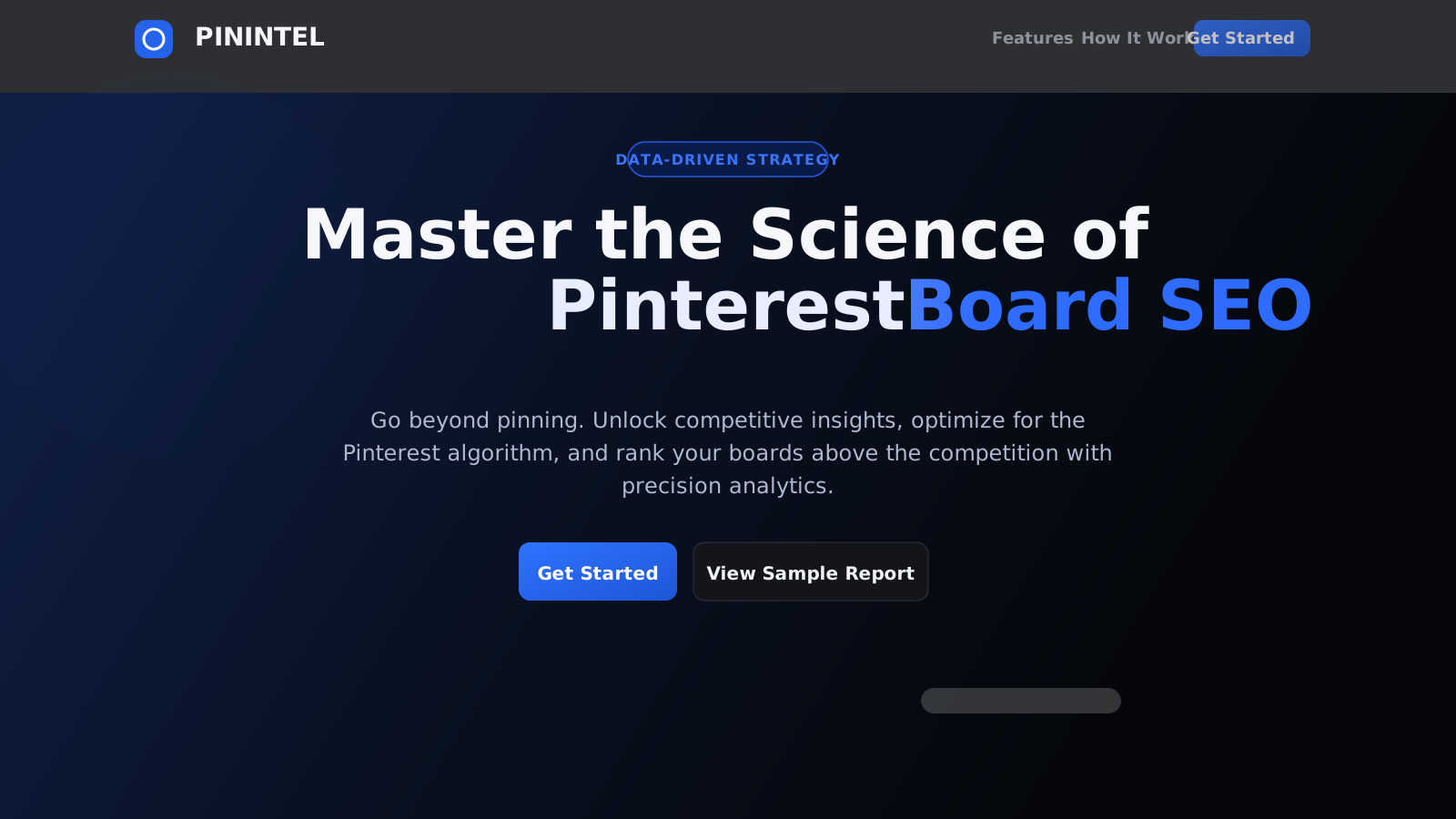
PinIntel Pro is a Generative Engine Optimization platform focused on Pinterest. It audits a target profile, benchmarks it against competitors, and translates that analysis into a prioritized growth plan.
- Extracts profile and board-level data from a target account and competitor set.
- Computes a proprietary Pinterest Health Score across 25 signals.
- Surfaces keyword gaps, profile structure issues, and consistency weaknesses.
- Generates an AI-written Growth Playbook with ranked recommendations.
It is not just a dashboard. The point is decision support.
The Technical Architecture
Building PinIntel Pro required three systems to work together: resilient extraction, domain-aware scoring, and an AI reasoning layer that could produce recommendations specific enough to be useful.
1. Data Extraction with Layered Fallbacks
Pinterest delivers much of its experience dynamically, so relying on a single extraction strategy is fragile. We built a three-layer pipeline so the system can degrade gracefully when the platform changes.
Layer 1: API Interception
Using Playwright, the backend launches Chromium and observes the network traffic generated during normal page interaction. When structured payloads are available, this gives us cleaner and more reliable profile data than scraping rendered HTML.
Layer 2: DOM Parsing
If network interception becomes unreliable, the system falls back to structured extraction from the rendered page using Cheerio. This layer targets stable semantic markers and layout patterns instead of brittle free-form scraping.
Layer 3: OCR via Tesseract.js
When both upstream layers fail, the service captures a screenshot of the rendered page and runs OCR over it with Tesseract.js. That gives us a last-resort path for recovering visible counts and labels directly from the UI.
Three layers, one goal: avoid dead ends.
2. A Scoring Engine Built for Pinterest Analysis
Raw extraction is not enough. PinIntel Pro processes the data through a weighted model that approximates the signals we care about most for Pinterest profile quality and discoverability.
- GEO Score: semantic richness across board names, descriptions, and profile language.
- Engagement Score: how saves, clicks, and related activity trend over time when that data is available.
- Consistency Score: posting cadence, format mix, and board completeness.
The overall Health Score is expressed as H = sum(w_i * s_i), where each metric score is weighted by its strategic importance. The weighting model is configurable so the system can evolve as the platform changes.
3. AI Reasoning with Amazon Bedrock and Amazon Nova
The scoring layer explains where a profile stands. The reasoning layer explains what to do next.
We integrated Amazon Bedrock as the inference layer and route tasks across the Amazon Nova family based on complexity and latency requirements. For text-heavy strategic synthesis, the platform packages score breakdowns, competitor deltas, and keyword gaps into a compact prompt and asks the model for a ranked Growth Playbook.
For visual review, we use a Nova model that supports image understanding. Profile screenshots are captured during analysis and passed as multimodal input so the model can comment on layout repetition, branding coherence, and creative consistency alongside the numeric scorecard.
4. Security Without Static Production Credentials
In production, PinIntel Pro runs on Amazon ECS with Fargate. The service is designed to use an IAM task role for runtime permissions, which keeps long-lived credentials out of the container environment. For local development, engineers can rely on the AWS SDK's default credential resolution chain, including environment-based configuration.
That gives us one code path across local and cloud environments without baking secrets into the application.
Why This Approach Works
The core pattern is simple: resilient extraction feeds a domain-specific scoring engine, which then feeds a model with curated context instead of raw noise. That separation matters.
Many AI marketing tools hand unfiltered data directly to a model and get back vague recommendations. PinIntel Pro does the opposite. The normalization and scoring layers do the analytical heavy lifting first. By the time the model sees the input, it is compressed, ranked, and high-signal. The result is strategy that is materially more specific.
The multimodal layer strengthens that further. Pinterest is visual by design, so quantitative analysis alone is incomplete. Combining numerical scoring with image-aware reasoning produces a more useful view of a profile than either one can deliver by itself.
The Future of Pinterest Intelligence
Pinterest is still a keyword-aware platform, but it is not only that. Relevance, organization, and creative quality all matter, and brands need tools that can reason across those dimensions together.
PinIntel Pro turns Pinterest analysis from guesswork into a structured decision system. It gives teams a way to measure profile quality, understand competitive gaps, and act on that analysis with a concrete playbook rather than another spreadsheet.
Related Reading
If you are building domain-specific AI products, explore our AI & Automation services, review shipped systems on the portfolio page, or read LangChain v1 vs LangGraph v1 for a production engineering perspective.
Need an AI system like this?
We build domain-specific intelligence tools that combine data pipelines, scoring models, and LLM reasoning into usable products.